05 February 2026

The Future of AI in Local Search

0 min read
The Future of AI in Local Search
Matt FordWritten ByMatt Ford

Responsible for delivering SEO strategies for our clients.

Local search is undergoing one of the most significant shifts in years. With the rise of generative AI, new user expectations around immediacy and context, alongside the enormous growth of voice-first assistants, how people discover nearby services is being reimagined.

For brands across hospitality, travel, food & drink and entertainment, understanding these local SEO trends isn’t just “nice to know”, it’s critical to staying visible in this increasingly competitive, algorithm driven landscape.

With 46% of all Google searches having local intent and over 60% now ending in zero-click experiences driven by AI search results and the Google AI Overview, brands can no longer rely on traditional rankings alone.

Now, we’ll explore how AI Overviews and voice search are reshaping Google, and what forward thinking brands should be doing now to stay in the game.

1. AI Overviews in Google SEO

In today’s search landscape, users are increasingly experiencing a zero-click search journey, where answers are delivered directly within Google, without the need to visit a website. This shift is being driven by Google’s Search Generative Experience (SGE), now rolling out more widely as AI generated overviews at the top of results pages.

A decade ago, local search was largely about ranking, optimising Google Business Profiles, and earning location based citations. Today, Google is embedding generative AI directly into the search experience, offering AI generated overviews that synthesise information from across the web into concise, conversational responses. This evolution has given rise to AI Overview SEO, where success is less about blue links and more about being selected as a trusted source within AI answers.

This changes local search in a few powerful ways:

Fewer clicks, more context: Users increasingly want instant answers. AI overviews surface key information, opening hours, reviews, pricing, menus, and services directly within the results page, accelerating the shift toward zero-click search.

Intent becomes king: With stronger natural language processing, Google can better understand why someone is searching, not just what they typed, prioritising intent over exact phrasing.

Less reliance on exact keywords: Traditional SEO focused on keyword matching is giving way to semantic relevance and contextual understanding, often referred to as entity SEO, where brands are recognised as entities with real world attributes, authority, and relationships.

For local brands, this means visibility isn’t just about ranking anymore, it’s about being the most useful, credible and well understood answer in your category.

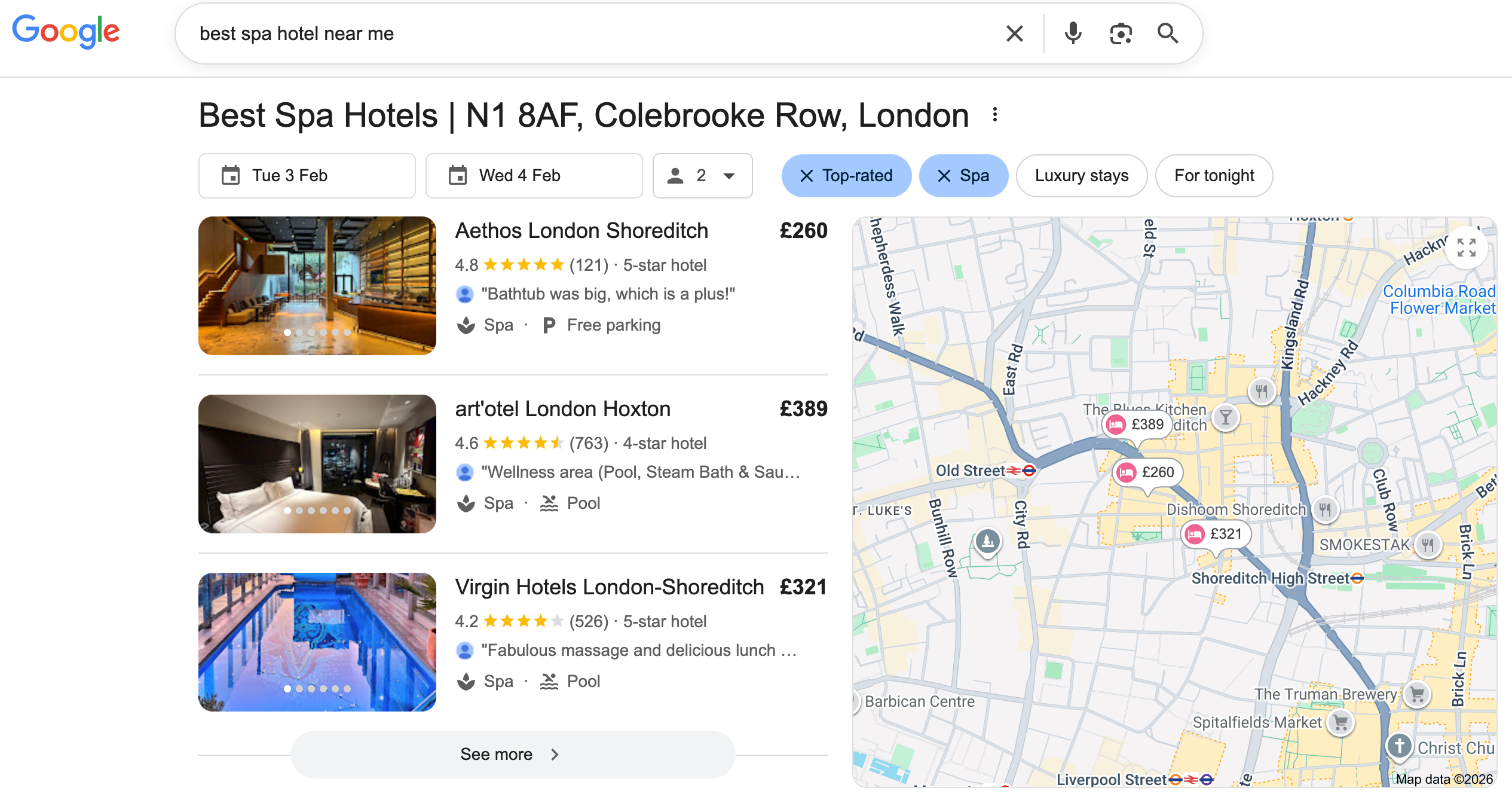
As an example, a search for “best spa hotel near me” may now trigger an AI generated summary highlighting top properties, reviews, amenities and pricing before traditional organic listings even appear.

 

2. Voice Search in Local SEO
Voice assistants like Google Assistant, Siri and Alexa are now deeply embedded into phones, cars, smart speakers and wearables, and they’re fundamentally changing how people search locally. As a result, voice search optimisation and conversational search SEO are becoming essential parts of any modern local strategy.

Instead of typing short queries, users speak in full sentences:

  • “Where’s a good cocktail bar open near me?”
  • “Best dog friendly cafés in Shoreditch?”
  • “What’s the closest hotel with a gym and spa?”

This has three major implications

  • Featured snippets and AI overviews become the prime real estate: These are what voice assistants read aloud.
  • Natural language matters more than ever: Content must reflect how people actually speak, not just how they type.
  • Structured data is critical: Google relies heavily on structured information (Schema markup, business profiles, reviews) to deliver confident voice responses.

In other words, search is becoming more about conversational search SEO, where brands that sound human, helpful and contextually relevant are the ones that win.

3. What This Means for Local Businesses & Marketers

So how should brands adapt to this new search landscape?

A. Optimise for Context, Not Just Keywords

Keyword optimisation still plays a role, but it needs to be supported by content that answers real user intent. That means:

  • Creating FAQ style content based on real customer questions
  • Writing in natural, conversational language

If your content can’t clearly answer a question, Google’s AI is unlikely to surface it.

B. Own Your Local Identity with Structured Data

Brands should ensure:

  • Google Business Profiles are complete and regularly updated
  • Consistent ‘Name, Address, Phone’ data across all platforms
  • Schema markup is implemented for locations, services, reviews and opening hours

These signals feed directly into AI overviews and voice search responses and determine whether Google trusts your brand as a reliable source.

C. Create Content for Voice First Users

The best performing local content today mirrors how people speak:

  • “Best brunch spots near London Bridge”
  • “Late night food delivery in Soho”
  • “Family friendly attractions in Brighton”

This kind of content isn’t just SEO friendly, it’s experience friendly. It meets users in real moments, with real needs.


4. The Competitive Edge

As AI increasingly curates search results, Google prioritises:

  • Strong user reviews
  • Accurate and up-to-date business data
  • High quality, genuinely helpful content
  • Brands with real world authority and relevance

Google is increasingly prioritising E-E-A-T (Experience, Expertise, Authority and Trust),  rewarding brands that demonstrate real world credibility and genuine value to users.


Let’s Future Proof Your Local Search Strategy

At Propeller, we help hospitality, travel and lifestyle brands stay visible as Google evolves, combining technical SEO, content strategy and data driven creativity.

Want to know how prepared your brand is for AI driven search?

Book a free call with our team and get a clear roadmap for staying competitive in 2026 and beyond.

Get in touch

And see how we'd drive results for you

Read more